
There's a good chance you'll soon be driving your truck internationally. It's useful to know the maximum weight you're allowed to drive. Not just in the Netherlands, but also in Belgium, Germany and other European countries, for example. That's why you'll find the maximum truck weight for each country here.
Domestic and cross-border transport
Good to know: all countries in Europe comply with European transport directive 96/53/EC. This directive states that the maximum weight of trucks in cross-border transport may not exceed 40 tonnes. This can be increased to 44 tonnes for intermodal transport, where goods are also transported partly by rail or water.
Please note: Some countries distinguish between domestic and international transport, or apply different limits to intermodal transport (road/rail combinations).
| Country | Maximum weight (tonnes) | Exception/intermodal |
|---|---|---|
| The Netherlands | 50 (LZV), 44 (5 axles), 40 (standard) | LZVs only on designated roads |
| Belgium | 44 | Sometimes stricter for 4 axles |
| Germany | 40 (standard), 44 (intermodal) | Intermodal: rail-road |
| Frankrijk | 44 (intermodal), 40 (other) | Only for combinations |
| Luxemburg | 44 (5 axles) | – |
| Austria | 40 | – |
| Spanje | 40 | – |
| Italy | 44 (in some cases), 40 (standard) | Intermodal, special routes |
| Polen | 40 | – |
| Switzerland | 40 | – |
Please note: Always check the current regulations in each country. Requirements may vary by vehicle type and route.
The Netherlands
In the Netherlands, the maximum weight of a truck is 50 tonnes. This applies to domestic transport and to the entire truck combination. So your tractor unit, trailer and load together must not weigh more than 50,000 kg. Please note: the maximum permitted weight may vary from truck to truck. For example, your truck may not be allowed on the road if it simply weighs more than permitted or if the axle load on any axle exceeds the limit specified on the vehicle registration certificate.
Belgium
In general, the maximum weight of a truck in Belgium is 44 tonnes, but this can be increased if you meet a number of additional requirements. In some cases, for example, you can drive a combination with 6 evenly distributed axles (3 on the tractor unit and 3 on the trailer) weighing up to 48 tonnes. If you drive a combination with alternative or zero-emission propulsion and stay within Belgium, the maximum permitted mass can even be increased to 50 tonnes.
Luxemburg
In Luxembourg, the maximum weight for trucks is also set at 44 tonnes for national transport and cross-border transport within the Benelux. Does your route also pass through Germany or France, for example? In that case, your truck combination may currently not weigh more than 40 tonnes.
Germany
The maximum weight of a truck in Germany is 40 tonnes. This applies only to trucks that transport their loads exclusively by road. When the goods being transported travel part of the way by rail or water, trucks are often allowed to weigh 44 tonnes (intermodal transport). The laws may differ by region, so always check with the local authorities for the current rules.
Maximum truck weight by country
These are the maximum truck weights in other European countries:
- In France, England, Italy, Portugal and Spain, the maximum weight of a truck for domestic transport is 44 tonnes.
- In Denmark, you may drive a three-axle truck and a three-axle trailer with a combined weight of 53 tonnes. A four-axle rigid truck with a three-axle trailer can even be driven with a maximum weight of 56 tonnes.
- In countries such as Poland, Greece and Switzerland, the maximum weight for domestic transport is 40 tonnes.
Higher weight limits for LZVs
All the weights listed above apply to conventional truck combinations. Different rules often apply to LZVs. LZV stands for Long and Heavy Vehicle Combination, also known as an Eco-combi. You can carry more freight with one of these than with a regular combination. For example, the maximum is 60 tonnes in the Netherlands, Belgium, Spain, Portugal and Norway. In Germany, the limit is still 40 tonnes.
How and where are checks carried out?
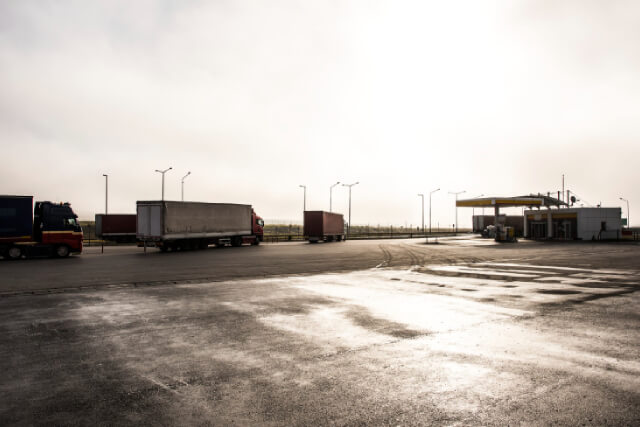
Weight checks are carried out using fixed or mobile weighbridges. In many countries, the police carry out random checks on roads or in car parks. There are also automatic weighing systems at major border crossings and on motorways.
Fines for exceeding the maximum weight
If you are caught overloaded, you can expect a substantial fine. In the Netherlands, this can run into thousands of euros, depending on how much you exceed the maximum weight by. Similar rules apply in Belgium and Germany. Sometimes you have to leave behind some or all of your cargo, or you may only continue driving after unloading the excess weight.
Learn more?
There are therefore quite a few different regulations when it comes to the maximum weight of your truck. And they are constantly changing, too. Fortunately, our truck theory course or, for example, a transport permit course will keep you up to date with the latest laws.