
TIR on trucks is a code that means trucks do not have to undergo extensive checks at every border. It is part of a smart customs system with minimal checks along the way. This saves both time and money. In this article, we’ll tell you more about TIR on trucks.
Meaning of the TIR abbreviation
TIR stands for Transports Internationaux Routiers (international road transport). This agreement was concluded in Geneva in 1975 with the aim of promoting more efficient road freight transport. Most European countries are members of this agreement. Several countries in Africa and Asia are also members.
TIR agreement: how does it work?
To use the TIR Convention, both the country where the transport begins and the country where it ends must be members. The truck is loaded in one country, and the goods remain sealed in the cargo area. A final inspection takes place only at the destination. This means there is no need for inspections at every national border. TIR therefore contributes to more efficient transport with fewer inspections.
Requirements for using TIR
As mentioned, the countries of origin and destination must be TIR countries. There are also a number of other requirements for using it:
- The carrier must be registered with a national TIR organisation.
- The vehicle must be approved for sealed transport.
- The goods must be transported in a closed cargo compartment.
- Only approved border crossings for TIR may be used.
- The truck is equipped with an approved TIR sign.
- The carrier must have a valid TIR carnet.
What does a TIR sign look like?
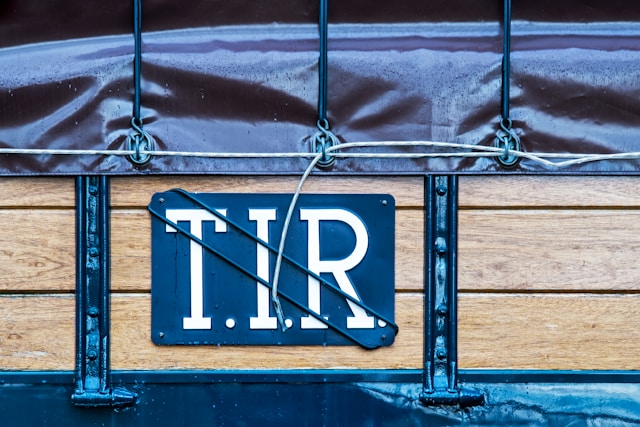
A TIR sign is a large blue rectangular sign bearing the abbreviation TIR in white capital letters. It must be clearly visible at both the front and rear of the truck and must not be obstructed in any way. The guidelines specify dimensions of 25 cm wide x 40 cm high, with the letters TIR at least 10 cm high. Approved TIR signs are available from specialist transport shops, among other places.
What is a TIR carnet?
As mentioned, a carrier must also have a valid TIR carnet, but what exactly is it? It is an international customs document showing that you are authorised to transport goods under the TIR agreement. You keep this accompanying document in the truck cab so you can show it to an inspector at any time if required.
How do you get a TIR carnet?
The national organisation TLN issues TIR carnets in the Netherlands. The vehicle must meet certain TIR safety requirements, such as having an approved seal on the cargo area. The required documents and permits are also needed to show that you are authorised to transport goods internationally as a carrier.
Driving a TIR truck: how does it work?
To give you a good idea of what driving a TIR truck involves, we’ll explain it in a few short steps.
- Departure
The truck is sealed and the TIR carnet is submitted to customs in the country of departure (the Netherlands, for example). - Customs inspection
Customs inspects the cargo and the carnet. If approved, you receive a customs stamp and can travel under TIR. - Transport
The vehicle remains sealed throughout the journey, with the TIR carnet serving as proof of sealed transport. - Arrival in other countries
Whenever you arrive at another national border as a driver, customs checks the carnet. You can then continue driving. - Arrival
Once you have arrived in the destination country, the seal is inspected. The TIR carnet is closed.
As a driver, you are expected to be familiar with TIR regulations to avoid problems and disputes with customs.
Become a truck driver? NuVrachtwagen!
Would you like to work as a truck driver, but don’t yet have the right driving licence? At NuVrachtwagen, you can pass your theory test in just one day! Choose a simple teaching method, short waiting times and competitive prices. From e-learning to in-person lessons, sign up now and get your truck driving licence.