
ADR is a European agreement containing rules on the safe transport of dangerous goods by road. Its purpose is to ensure safe and responsible transport so that dangerous goods can be transported properly. In this article, we’ll tell you about the rules surrounding ADR.
Meaning of the abbreviation ADR
The abbreviation ADR originally stands for Accord Européen relatif au transport international des marchandises Dangereuses par Route. The English abbreviation Agreement concerning the International Carriage of Dangerous Goods by Road is also sometimes used. The ADR agreement was established in Geneva as early as 1957. Today, we abbreviate it to ADR.
What is ADR transport?
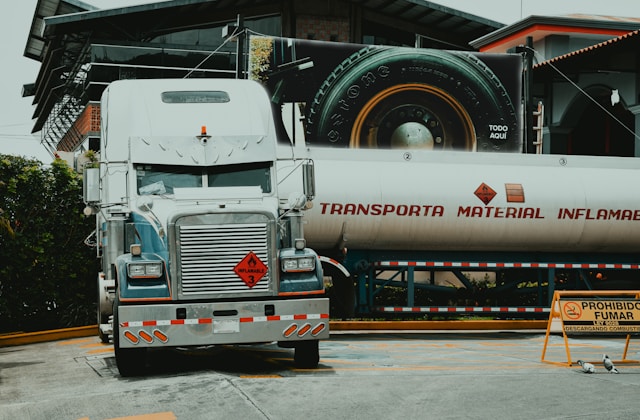
ADR transport is the carriage of dangerous goods by road in accordance with ADR regulations (strict safety requirements). Dangerous goods include fuels, acids and gases, as well as specific products such as fireworks, paint, pesticides and batteries.
For ADR transport, the company in question must ensure that the transport complies with certain rules and guidelines. These include specific requirements for packaging, labelling and documentation. The purpose of ADR transport is to ensure that these dangerous goods are transported safely and under controlled conditions.
ADR 2025
The ADR is a European agreement that more than 50 countries are now party to. Belgium began following the ADR in 1960. Three years later, in 1963, the Netherlands followed suit. Drivers who drive in Europe must follow its guidelines.
The ADR is also reviewed periodically and revised where necessary in line with the latest laws and regulations. ADR 2025 has been in effect since 1 January 2025, with a number of stricter rules, such as new UN numbers for powered vehicles using lithium-ion, lithium-metal and sodium-ion batteries, and more detailed transport documentation that must be kept in the cab during transport.
ADR classes
The ADR is divided into 9 classes, which categorise dangerous goods.
- Class 1: Explosive substances and articles
- Class 2: Gases
- Class 3: Flammable liquids
- Class 4: Flammable solids
- Class 5: Oxidizing substances
- Class 6: Toxic substances
- Class 7: Radioactive substances
- Class 8: Corrosive substances
- Class 9: Miscellaneous dangerous substances and articles
Can everyone transport ADR goods?
No! To transport dangerous goods covered by the ADR, you need an ADR professional competence certificate as a driver. This is a basic certificate that allows you to transport many types of goods. In exceptional cases, a specialisation is also required. This applies, for example, to the transport of explosives and radioactive substances.
Basic ADR Certificate for drivers
You can obtain the ADR Basic Certificate through the CBR. The exam includes questions about important types of hazards, environmental protection, labelling, orange plates and the safe transport of hazardous substances in general. You must answer at least 18 of the 25 questions correctly to pass the theory exam. A pass is valid for 1 year. You must then also complete practical training with a CBR-accredited ADR training provider. Once you have obtained the ADR Basic Certificate, it remains valid for 5 years. After that, you can take a renewal exam.
Awareness course for co-drivers
Are you not driving the truck yourself, but joining as a co-driver? Then you do not need an ADR certificate. However, you must have completed an awareness course. During this course, the person must be made aware of the dangers and risks associated with the work in question, and how to deal with them safely. The company may provide this course itself (without an exam) and must be able to show that the co-driver has completed it. An awareness course is also mandatory for everyone else involved in packaging or transporting ADR substances.
Vehicle also needs an ADR certificate
Once the driver has an ADR certificate, that’s not all. The vehicle itself must also be inspected before it is allowed on the road. The RDW issues ADR certificates for vehicles such as trucks. To keep the certificate valid, the vehicle must be inspected annually at an RDW inspection station. Does the vehicle have an ADR tank? It must be inspected separately every 3 years.
Compliance with ADR: Human Environment and Transport Inspectorate
The Human Environment and Transport Inspectorate (ILT) monitors carriers of dangerous goods and provides information and advice to transport companies. Check the ADR regulations to find out the specific requirements for your situation so that you can comply with them.
If a substance is slightly hazardous but is not covered by the ADR, the vehicle does not need an ADR certificate. As a driver, you must still meet a number of other requirements. For example, a driving licence with Code 95 is mandatory.
Theory or Code 95 training with NuVrachtwagen
Would you like to work as a truck driver transporting dangerous goods, and do you still need to pass your theory exam or obtain Code 95? Then NuVrachtwagen is the right place for you. With us, you benefit from short waiting times, high pass rates and simple teaching methods. This means you can get started as soon as possible doing what you really want to do: driving on the road. Sign up now for your preferred course, location and date, and pass your theory exam or obtain Code 95 in no time.